
Disclosure: We may earn a commission if you use some links on this page, at no extra cost to you.
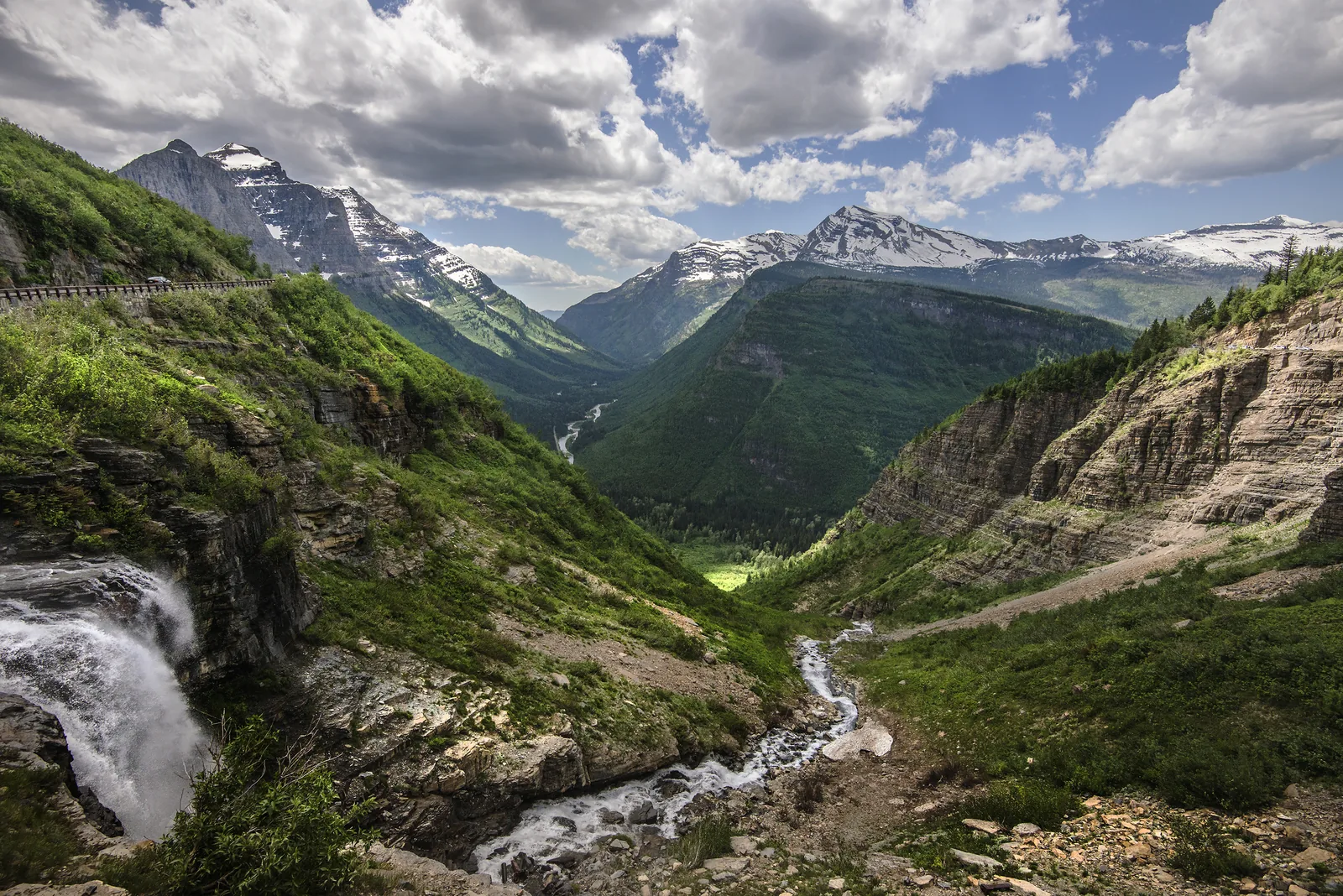
Going-to-the-Sun Road is the only road that crosses Glacier National Park from west to east, and for most visitors it is the trip. It runs about 50 miles from the West Glacier entrance to St. Mary, climbs over the Continental Divide at Logan Pass, and passes the trailheads, lodges and overlooks that fill most Glacier itineraries. It is also a seasonal, size-restricted mountain road with rules that change from year to year, which is why this guide leads with the practical facts: when it opens, what you are allowed to drive on it, and how Logan Pass parking and shuttles worked in 2026, the most recent season.
One point up front, because it drives every booking decision: the National Park Service has not announced its access rules for next summer. In 2026 there were no vehicle reservations anywhere in Glacier, and the park replaced them at Logan Pass with a three-hour parking limit and a ticketed shuttle. Treat the 2026 system described below as the best guide to what to expect, not as a promise, and check the park’s vehicle reservations page summary and NPS before you lock in dates.
AI-assisted research and drafting; checked against official sources (listed below with dates). Edited by Eric – Montana Raised
The short version
- About 50 miles from West Glacier to St. Mary, crossing Logan Pass at 6,646 feet; about 2 hours without stops, a full day with stops and hikes.
- Typically fully open by early July (June 22 in 2026); alpine sections typically close around the third Monday of October.
- No vehicle reservations anywhere in Glacier in 2026; next summer’s rules not yet announced.
- Entrance pass: $35 per private vehicle for 7 days in summer; the park does not accept cash.
- Vehicle limits: max 21 ft long and 8 ft wide between Avalanche Creek and Rising Sun.
Quick facts
| Item | Detail |
|---|---|
| Length | About 50 miles, West Glacier (west entrance) to St. Mary (east entrance) |
| Drive time | About 2 hours without stops; plan a full day with stops and hikes |
| Highest point | Logan Pass, 6,646 feet — 32 miles from the west entrance, 18 miles from the east |
| Full opening | No set date; typically fully open by early July (June 22 in 2026) |
| Seasonal closing | Alpine sections typically close around the third Monday of October, earlier in bad weather |
| Vehicle limits | Max 21 ft long (bumpers included), 8 ft wide (mirrors included) between Avalanche Creek and Rising Sun; vehicles over 10 ft tall may have difficulty west of Logan Pass |
| Speed limit | 40 mph at lower elevations, 25 mph in the alpine section |
| Entrance pass | $35 per private vehicle for 7 days in summer ($25 winter rate, Nov. 1–Apr. 30); the park does not accept cash |
| Vehicle reservations | None required anywhere in the park in 2026; next summer’s rules not yet announced |
| Logan Pass parking (2026) | 3-hour limit, July 1–Sept. 7, enforced 24 hours a day, with a free timestamped permit from the on-site kiosk |
| Fuel | No gas stations inside the park; fuel up in West Glacier or St. Mary |
| Cell service | Assume none along most of the road; download maps and tickets in advance |
When does Going-to-the-Sun Road open and close?
There is no fixed opening date, and the park says so plainly: the summer opening of the alpine portion varies with snowfall and plowing progress, and predicting an exact date is impossible. The pattern to plan around:
- Plowing starts in early April. Crews work across roughly 40 avalanche paths, and clearing the road, the Logan Pass parking lot and the visitor center area takes most of the spring. Snowstorms and avalanches continue through May and can force crews to re-plow sections.
- Logan Pass typically opens between mid-June and early July. In 2026 the full road opened on Monday, June 22. In the ten seasons before that, the full opening fell between June 13 and July 13, which is why the second half of July and August are the safe window for a trip built around crossing the pass.
- Progress is public. Through the spring, NPS posts where the plows are working on its plowing and road status page, publishes plowing photos in an annual Flickr album, and sends road opening and closing alerts by text (text GNPROADS to 333111). Before the road opens to cars, sections are usually open to hikers and cyclists as far as the plows and closures allow.
- The lower sections never really close. The road near the West Entrance is open year-round, and the Lake McDonald and St. Mary valley sections open well before the pass does.
- Closing comes in the fall. The alpine sections typically close for the winter around the third Monday of October, and storms can close them earlier at any point. In 2026 the park first put a temporary alpine closure in place on October 9.
If crossing Logan Pass is the point of your trip, build your dates around late July or August and keep a backup day. Our Glacier trip planner walks through how to sequence a trip around the road’s season.
Reservations and entrance passes
Vehicle reservations: none in 2026. Glacier ended the timed-entry vehicle reservation system that ran for five summers. In 2026 no vehicle reservation was required anywhere in the park — not for Going-to-the-Sun Road, Many Glacier, Two Medicine or the North Fork. The park has not announced whether any reservation system returns next summer.
An entrance pass is still required. Every vehicle needs a park entrance pass: $35 for a private vehicle for seven days at the summer rate, or $25 at the winter rate (November 1 to April 30). A Glacier annual pass or an America the Beautiful pass also works. The park does not accept cash, so buy at the entrance station by card or purchase your pass in advance. Note for international visitors: in 2026, non-U.S. residents aged 16 and over paid an additional $100 per-person fee unless they entered on an annual or America the Beautiful pass.
Congestion can still turn you around. When an area fills up — Logan Pass and Many Glacier especially — the park may temporarily restrict access to let traffic clear. Arriving early is the simplest insurance.
For the year-by-year history of the reservation systems and what to watch for in the next announcement, see Glacier vehicle reservations explained.
Vehicle size limits and road rules
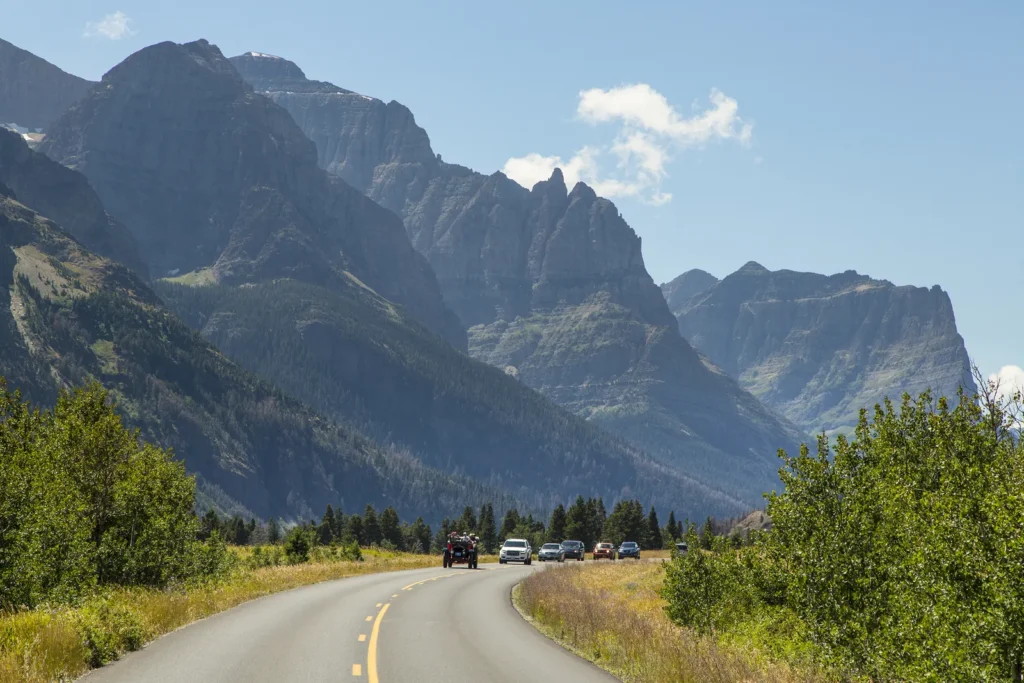
The alpine section of Going-to-the-Sun Road was built in the 1920s and early 1930s for the cars of that era, and the size limits are strict:
- Length and width: Vehicles and vehicle combinations longer than 21 feet (bumpers included) or wider than 8 feet (mirrors included) are prohibited between Avalanche Creek and Rising Sun. That covers most RVs, all trailers, and many large trucks with tow mirrors extended. Oversize vehicles can reach Packers Roost from the west and Siyeh Bend from the east, but cannot cross the pass.
- Height: Vehicles over 10 feet tall may have difficulty driving west from Logan Pass to The Loop because of rock overhangs.
- Speed: 40 mph on the lower sections and 25 mph in the alpine section, with blind curves where animals and pedestrians cross without warning.
- Fuel and services: There are no fueling stations inside Glacier’s boundaries. Food and lodging sit along the road at Apgar Village, Lake McDonald Lodge and Rising Sun in summer, and five of the park’s campgrounds — Apgar, Sprague Creek, Avalanche, Rising Sun and St. Mary — are on or near the road.
Renting a car for Glacier? Rent a standard car or small SUV, not the free upgrade to the biggest vehicle on the lot — anything over the 21-foot limit cannot legally cross the pass. Compare rentals for West Glacier and Kalispell pickup on Discover Cars (affiliate link).
Logan Pass: the 2026 parking limit and ticketed shuttle
Logan Pass is the road’s high point at 6,646 feet, with the visitor center, the Highline and Hidden Lake trailheads, and a parking lot of 235 spaces that, in the park’s words, usually fills by sunrise. In 2026 the park piloted two tools to manage it, running July 1 through Labor Day, September 7, 2026:
Three-hour timed parking. Private vehicles parked at Logan Pass were limited to three hours, enforced 24 hours a day. The system was simple: park in an open space first, then take a free, timestamped permit from the on-site kiosk and put it on your dashboard. On most days the park issued 1,200–1,300 of those permits, and the turnover meant spaces kept opening through the day instead of the lot locking up at dawn. Three hours is enough for the visitor center and the hike to Hidden Lake Overlook. Overnight parking was not allowed except for permitted backcountry users and Granite Park Chalet guests.
The ticketed Logan Pass Shuttle. The old free, first-come shuttle was replaced in 2026 by a reservation-only express shuttle built for people who need more than three hours at the pass — above all, Highline Trail hikers. The rules:
- Every rider age 2 and older needed their own ticket, booked on Recreation.gov; the only cost was a $1 processing fee per ticket, and tickets were not sold in the park.
- Tickets were released in two windows: a portion 60 days ahead on a rolling basis starting May 2, and the rest at 7 p.m. MDT the evening before, starting June 30.
- Boarding points were Apgar Visitor Center and Lake McDonald Lodge on the west side, and St. Mary Visitor Center and Rising Sun Picnic Area on the east side, with early express departures from 6 a.m.
- Shuttles ran express to Logan Pass. They did not stop at Avalanche Creek in 2026, so Trail of the Cedars and Avalanche Lake were not reachable by park shuttle that year.
After September 7, 2026, the time limit and shuttle ended for the season and Logan Pass parking went back to first-come, first-served until the alpine road closed. Whether either program returns next summer is part of what NPS has not yet announced. The park reported the pilot worked as intended — more visitors got a reliable shot at Logan Pass — so plan as if something similar may come back, and check the park’s Visiting Logan Pass page when you book.
Prefer to leave the driving to someone else? Guided and self-guided tours cover the road in season. The Going-to-the-Sun Road self-guided audio tour on Viator narrates the drive stop by stop, and GetYourGuide lists Glacier driving tours and west-side trips if you’d rather ride than drive. (Affiliate links — booking through them costs you nothing extra and helps keep Montana Wayfinder running.)
The stops, west to east
Mileages below are from the West Glacier entrance. Drive it in this order, or reverse it from St. Mary — the same stops work either direction, and many visitors prefer the east-to-west drive so the drop-offs are on the far side of the road.
Apgar Village and Apgar Visitor Center (about 2 miles). The first stop inside the west entrance, at the south end of Lake McDonald: trip-planning help, restrooms and water, the Apgar Campground and a shuttle boarding point. Get your Logan Pass questions answered here, before you lose cell service.
Lake McDonald Lodge (about 10 miles). The historic lodge on the east shore of Lake McDonald, with a camp store, dining, and boat tours on the lake in season. There is an EV charging station across from the camp store, and the lodge area was a 2026 shuttle boarding point for Logan Pass. For a half-day on the river nearby, try a scenic Glacier raft trip on GetYourGuide.
Avalanche Creek and Trail of the Cedars (about 16 miles). The road’s best short stop on the west side: the Trail of the Cedars is an accessible 0.7-mile loop through old-growth cedar and hemlock, and the Avalanche Lake trail continues from it. Avalanche is also where the vehicle size restriction begins. Note that in 2026 the park shuttle did not serve Avalanche, so plan to drive and arrive early for parking.
The Loop (about 24 miles). The road’s one tight switchback, where the climb turns toward the pass. The Loop Trail climbs 4.2 miles one way to Granite Park Chalet — how many Highline hikers finish a one-way Logan Pass-to-Loop hike.
Weeping Wall and the alpine climb. Above The Loop the road is carved into the cliff face, passing the Weeping Wall, where snowmelt pours over the retaining wall in early summer. This is the stretch with the rock overhangs that tall vehicles struggle with, and the slowest driving on the route.
Logan Pass (32 miles). The Continental Divide at 6,646 feet: visitor center (open 9 a.m. to 7 p.m. in peak season in 2026, closing for the season in late September), restrooms, water in season, and alpine meadows where mountain goats and bighorn sheep are consistently seen nearby. The Highline Trail starts across the road from the parking lot; the Hidden Lake trail starts behind the visitor center. Everything in the parking and shuttle section above applies here — this is the one stop to plan your day around.
Jackson Glacier Overlook (about 37 miles). Five miles east of Logan Pass, this is the one place on the road where a glacier — Jackson Glacier, the park’s seventh largest and the easiest to see — is visible from an overlook. If you see one east-side pullout, make it this one.
Siyeh Bend (about 39 miles). Where the road bends out of the alpine and starts down toward St. Mary Lake. The trailhead here serves two of the park’s big day hikes: Siyeh Pass (4.6 miles one way) and Piegan Pass (4.5 miles one way). Oversize vehicles coming from the east can reach Siyeh Bend but no farther.
Sun Point and the St. Mary Lake shore (about 43 miles). The road drops to the north shore of St. Mary Lake, with the Sun Point Nature Trail and picnic area, and the short walks to Baring Falls (0.3 mile from Sunrift Gorge) and St. Mary Falls (0.8 to 1.2 miles depending on the trailhead). The small island mid-lake is Wild Goose Island.
Rising Sun (about 44 miles). Motel, camp store, restaurant and campground on St. Mary Lake, plus a shuttle boarding point in 2026 and boat tours from the dock in season. It is the last services stop before St. Mary, and the east end of the size-restricted section.
St. Mary and the east entrance (50 miles). The road ends at the St. Mary Visitor Center and the town of St. Mary, with fuel, food and lodging outside the entrance. From here, Many Glacier is about a 40-minute drive north (20 miles) — an easy add to a road day if you have the time, and covered in our Glacier National Park hub.
Building a full itinerary around the drive? Our Glacier 3-day itinerary puts the road on Day 2 with a split stay — one night on the west side, two on the east — and our guide to where to stay near Glacier compares the gateway towns on both ends.
Trailheads on the road
You could fill a week with hikes that start from this one road. The essentials, all with one-way distances from NPS:
- Trail of the Cedars, Avalanche Creek — 0.7-mile accessible loop; the longer Avalanche Lake trail branches off it.
- Hidden Lake Overlook, Logan Pass — 1.4 miles one way, 460 feet of gain, much of it on boardwalk; add 1.2 miles and a 780-foot drop to continue to Hidden Lake itself. Fits inside the three-hour parking limit.
- Highline Trail, Logan Pass — 7.6 miles one way to Granite Park Chalet, or 11.8 miles one way through to The Loop, with 2,388 feet of gain and 4,773 feet of loss on the through-route. A longer-than-three-hours hike — in 2026 this was the hike the ticketed shuttle existed for.
- Loop Trail, The Loop — 4.2 miles one way up to Granite Park Chalet, 2,200 feet of gain.
- Siyeh Pass and Piegan Pass, Siyeh Bend — 4.6 and 4.5 miles one way respectively, both big alpine days.
- St. Mary Falls and Baring Falls, east side — 0.8–1.2 miles and 0.3 mile one way; easy add-ons to a drive day.
Trail conditions change fast — snow can close the Highline well after the road opens (it was still closed for snow on opening day in 2026), and closures for bear activity happen at any trailhead. Check the park’s trail status page the morning you hike, and carry bear spray where you can reach it. Our roundup of the best hikes in Glacier National Park ranks these against the rest of the park.
Cycling Going-to-the-Sun Road
In spring, before the road opens to cars, the plowed sections are one of the great bike rides in the national park system, and hikers and cyclists can usually go as far as the day’s closure points allow. Once the road is fully open, time-of-day restrictions apply to the narrow west-side climb — and here the park’s own pages currently disagree, so check the current road status page before you ride:
- The park’s directions page (updated May 2026) lists the Apgar-to-Logan Pass section as closed to bicycles June 13 through September 28, eastbound between 12 p.m. and 6 p.m. and westbound between 3 p.m. and 6 p.m.
- The park’s Going-to-the-Sun Road general information page lists a simpler rule for its season: bicycles prohibited between the Apgar turnoff and Logan Pass between 3 p.m. and 6 p.m. only.
Either way, riding is unrestricted outside the listed hours, and there was no park-run hiker/biker shuttle in spring 2026 — permitted local outfitters offered bike rentals and transport instead. Ride early, use lights in the tunnels and on cliff sections, and expect gravel where road rehabilitation is underway.
Driving tips
- Start early or late. Logan Pass parking historically fills by sunrise in peak season. An early start still buys you quiet roads, better light and active wildlife.
- Let the passenger look. The driver will see mostly road — blind curves, low stone guardwalls and big drop-offs demand it. Swap drivers at Logan Pass, or drive the road in both directions on different days.
- Budget more time than the map says. Two hours is the no-stops drive time. With the main stops and one short hike, the crossing is a 4–6 hour day; with a Logan Pass hike, it is a full day.
- Fuel up and download everything. No gas in the park and thin-to-no cell coverage. Screenshots and offline maps are the backup plan.
- Weather at the pass is not weather at the lake. Wind, cold and icy patches are normal at Logan Pass on opening day and possible all summer; pack a layer and real shoes even if the valley is warm.
- Give wildlife the road. Goats and sheep near Logan Pass and bears on the east side around Two Dog Flats are routine. Stay in the car for roadside bears, never stop in the travel lane, and keep the park’s required distances — 25 yards from most animals, 100 yards from bears and wolves.
- Know your vehicle’s numbers before the entrance. Measure length bumper-to-bumper and width mirror-to-mirror. If you are over 21 feet or 8 feet, plan to enter from one side only, or use a tour or shuttle for the crossing.
A short history
Going-to-the-Sun Road was built to blend into its mountains — bridges, retaining walls and guardrails were made from native rock taken from the road cuts themselves — and it remains a National Historic Landmark. The final section over Logan Pass was completed in 1932 after 11 years of construction, the first automobile crossed the full 50 miles that fall, and the road was formally dedicated at Logan Pass on July 15, 1933. Every spring’s plowing fight, and every rehabilitation closure since, is the cost of keeping a 1930s mountain road open across the Continental Divide.
FAQ
Do I need a reservation to drive Going-to-the-Sun Road?
In 2026, no — vehicle reservations were not required anywhere in Glacier National Park. The park has not announced its rules for next summer. You always need an entrance pass ($35 per vehicle for seven days at the summer rate).
When does Going-to-the-Sun Road open?
There is no set date. Plowing starts in early April, and Logan Pass typically opens between mid-June and early July — June 22 in 2026. The park posts plowing progress on its road status page each spring. The alpine section typically closes around the third Monday of October.
Can I drive an RV or trailer over Logan Pass?
No. Vehicles and combinations longer than 21 feet or wider than 8 feet are prohibited between Avalanche Creek and Rising Sun, which rules out trailers and most RVs. Vehicles over 10 feet tall may also have difficulty with rock overhangs west of Logan Pass.
How long does it take to drive Going-to-the-Sun Road?
About 2 hours for the full 50 miles without stopping. With stops, photos and a short hike, plan on 4–6 hours; with a longer Logan Pass hike, plan a full day.
How does Logan Pass parking work?
In 2026, from July 1 to September 7, parking at Logan Pass was limited to three hours, enforced 24 hours a day: park first, then pick up a free timestamped permit at the on-site kiosk for your dashboard. The lot has 235 spaces and historically fills by sunrise, so arrive early. Outside those dates it was first-come, first-served.
What if I want to hike the Highline Trail?
The Highline runs 11.8 miles one way from Logan Pass to The Loop (or 7.6 miles to Granite Park Chalet), which does not fit in a three-hour parking window. In 2026 the park ran a ticketed express shuttle to Logan Pass for exactly this: $1 processing fee per ticket on Recreation.gov, every rider age 2 and up, with early departures from 6 a.m. Check whether the shuttle returns before your trip.
Sources
All sources checked November 23, 2026.
- National Park Service, Going-to-the-Sun Road General Info — road length and drive time, Logan Pass elevation and distances, vehicle size restrictions, speed limits, plowing and opening/closing patterns, amenities and campgrounds. https://www.nps.gov/glac/planyourvisit/gtsrinfo.htm
- National Park Service, Directions, Transportation, & Road Conditions (updated May 7, 2026) — bicycle restriction dates and times, road opening and closing guidance, text alerts. https://www.nps.gov/glac/planyourvisit/directions.htm
- National Park Service news release, Glacier National Park Announces 2026 Summer Operations (Feb. 18, 2026) — no vehicle reservations in 2026, ticketed shuttle and three-hour Logan Pass parking pilot, ticket release windows, plowing start and avalanche paths. https://home.nps.gov/glac/learn/news/glacier-national-park-announces-2026-summer-operations.htm
- National Park Service news release, Glacier National Park Remind Visitors About 2026 Shuttle System and Logan Pass Access Changes (Apr. 17, 2026) — elimination of vehicle reservations, reservation-only shuttles, three-hour parking from July 1. https://www.nps.gov/glac/learn/news/glacier-national-park-remind-visitors-about-2026-shuttle-system-and-logan-pass-access-changes.htm
- National Park Service, Visiting Logan Pass in 2026 — parking permit process, July 1–Sept. 7 dates, 24-hour enforcement, shuttle boarding locations. https://www.nps.gov/glac/planyourvisit/visiting-loganpass-2026.htm
- National Park Service news release, Glacier National Park Provides Updates on the 2026 Shuttle System and Logan Pass Parking (Sept. 8, 2026) — season end for shuttle and timed parking, 235 Logan Pass spaces, 1,200–1,300 daily permits, visitor center hours. https://www.nps.gov/glac/learn/news/glacier-national-park-provides-updates-on-the-2026-shuttle-system-and-logan-pass-parking.htm
- National Park Service news release, Going-to-the-Sun Road Open for the 2026 Season (June 23, 2026) — full opening June 22, 2026, size restrictions restated. https://www.nps.gov/glac/learn/news/going-to-the-sun-road-open-for-the-2026-season.htm
- National Park Service, Fees & Passes — $35 summer / $25 winter seven-day vehicle pass, cashless entry, $100 nonresident fee, annual pass price. https://www.nps.gov/glac/planyourvisit/fees.htm
- National Park Service, Hiking St. Mary and Highline Trailhead and Drive Going-to-the-Sun Road — trail distances and elevation changes for Hidden Lake Overlook, Highline, Siyeh Pass, Piegan Pass, St. Mary Falls and Trail of the Cedars; Jackson Glacier Overlook position. https://www.nps.gov/glac/planyourvisit/hikingstmary.htm · https://www.nps.gov/places/highline-trailhead.htm · https://www.nps.gov/thingstodo/drive-gtsr.htm
- National Park Service, Going-to-the-Sun Road — An Engineering Feat and 75th anniversary release — completion of the Logan Pass section in 1932, first full crossing fall 1932, dedication July 15, 1933, National Historic Landmark status. https://www.nps.gov/glac/learn/news/upload/Going-to-the-Sun-Road-An-Engineering-Feat.pdf · https://www.nps.gov/glac/learn/news/going-to-the-sun-road-75th-anniversary.htm
Montana Wayfinder is not affiliated with the National Park Service. Rules change — confirm road status, restrictions and reservation rules on nps.gov before you travel.